


US venture capital just had its biggest half-year on record: $412.7 billion deployed in the first six months of 2026. Deals under $100 million took 12.5% of it — $51.4 billion, split across every US venture deal below that threshold.
Inside that same record half-year, the median seed round went the other way. $3.0 million so far in 2026, down from $3.5 million across 2025 — the only stage where the median fell while every other series rose.
A record amount of money invested but shrinking seed rounds point to the same thing. The money is stacking up at the top.
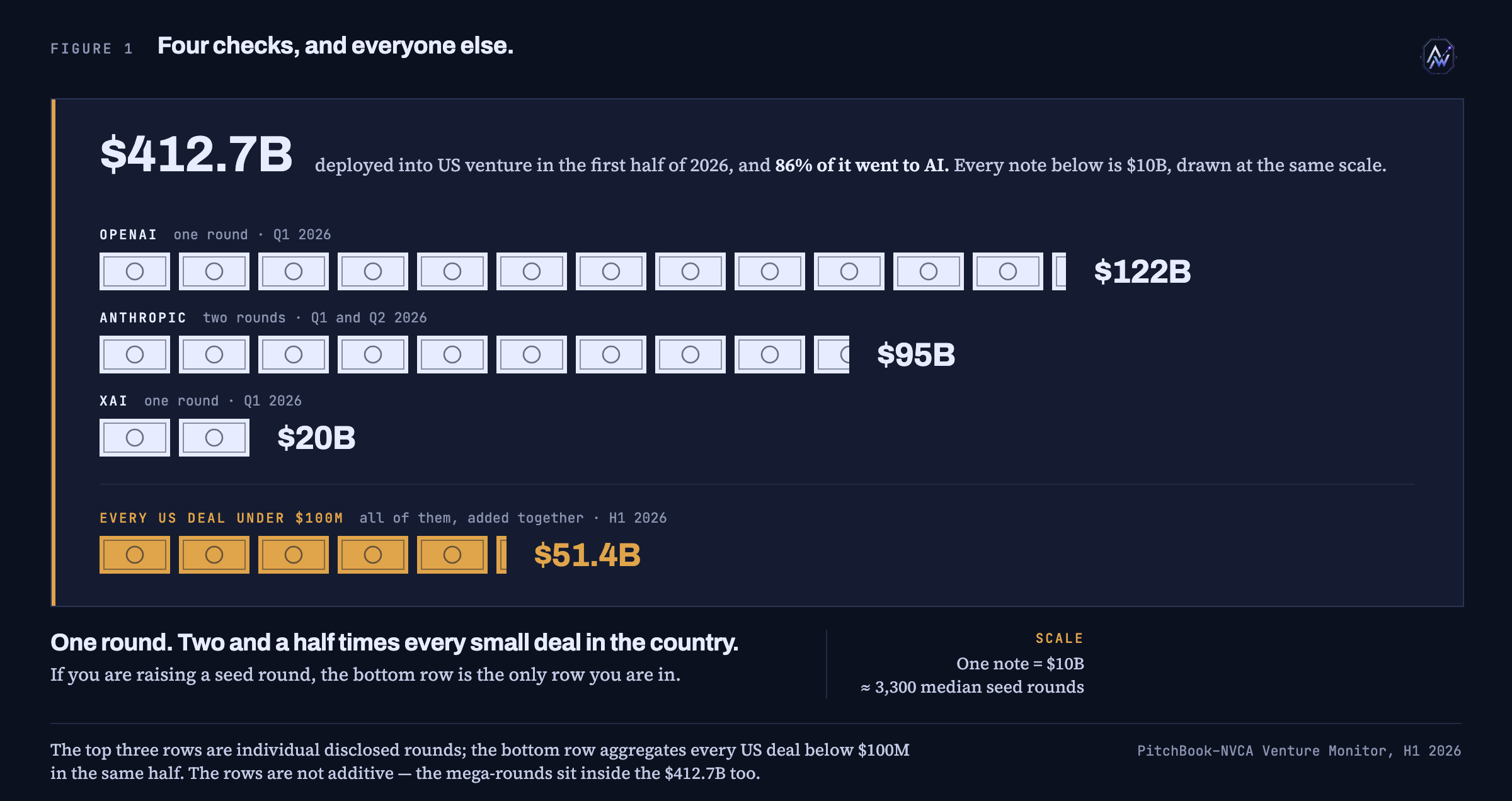
Put the individual checks side by side and the shape stops being abstract. OpenAI raised $122 billion in a single round. Anthropic raised $95 billion across two. xAI raised $20 billion. Every US venture deal under $100 million — every seed, every Series A, every small round cut in the country over six months — came to $51.4 billion between them.
One company’s round was worth more than twice that entire market.
That behavior is consistent with a narrative I hear everywhere: how AI has made starting a company so cheap. After all, if building a company is cheap now, startups should need less money.
There are two unspoken assumptions in that assertion worth challenging. First, that building a product is the same as building a company. Second, that all other costs aside from product development also stay the same or go down.
I don’t dispute that building software is cheaper with AI. The other assumptions, however, don’t hold up for me.
The question nobody seems to be asking is: what are the second- and third-order effects of making software dramatically cheaper and easier to build? Ignoring that line of thinking is likely to lead a lot of founders — and a fair number of investors — down the wrong path.
Subscribe free to keep reading
Get the rest of this essay—and future field notes on building companies in the AI era—delivered to your inbox.