

Earlier this year, I built Chief, an AI chief of staff for myself. By August, I felt like I was on a collision course with Anthropic, OpenAI, and Meta, so I pulled the plug. Then Instinct, the viral AI assistant, raised $1B at a $10B valuation, and I was left scratching my head. Did I make a mistake when I stopped actively building Chief?
Why Chief
I’ve had an executive assistant for most of my professional career and I rely on them heavily. When I left Klaviyo, it didn’t make sense to put someone on my personal payroll when theoretically I finally had time to manage my own email and calendar.
I still didn’t want to do those things, though :)
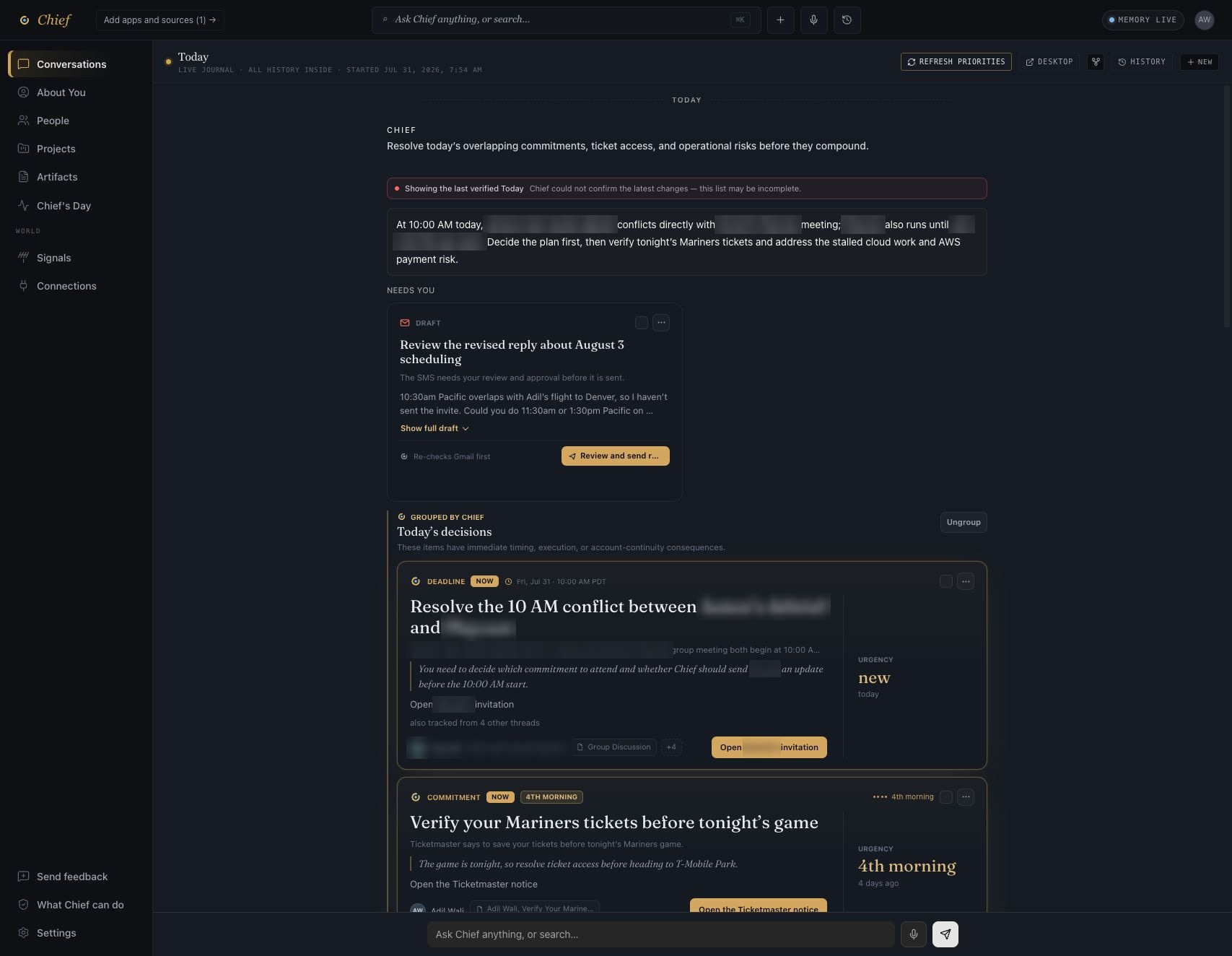
So I set out to build an assistant that could know my preferences, my priorities, and keep me on track. I imagined a proactive employee that would have a daily morning brief, summarize my most important emails, draft background notes for meetings that day, and understand the key people in my life.
I built it, and it worked. It actually worked exceptionally well.
I had an intense amount of fun iterating on it. I am highly technical, but I wouldn’t have been able to build this on my own until AI came along, which made solving these problems even more interesting.
Chief booked restaurant reservations for me, prepared briefing notes for upcoming meetings, and texted with my friends and family. It summarized and processed my inbox and highlighted what I needed to focus on. It even cajoled me when I didn’t follow up on things I said I would.
The core of Chief was ultimately a memory system that was built for AI to use rather than humans. The belief was (and still is) that the best UI for a personal database is an AI agent. It just needs the right tooling under the hood.
Why I Pulled the Plug
So why pull the plug? First, as cool and useful as it was, it felt like a second door to the agents in my life and it was competing with a primary door (Codex and Claude Code) that was so ingrained in my routine that it would be tough to displace it. I concluded: If that was my case, it would be everyone else’s.
Second, it was clearly on a collision course with what the frontier labs were doing. I built a Chrome plugin early in the Chief journey so it could drive the browser for me. Then I built a credential/secret storage system. Then I built connectivity to iMessage and WhatsApp. And at every step, it felt obvious and clear to me that the frontier labs would ship the same things (which they mostly have done).
We can’t forget that Anthropic and OpenAI own the models, have unlimited funding, and can subsidize any product they want to for as long as they want to. As they started to connect to people’s email, calendars, and documents, I predicted they would quickly come for this problem space and build it into their own products, making a standalone tool no longer a viable business.
It was also very expensive to run, which would be fine if it were just a productivity tool for me. The expensive part wasn’t talking to it. It was everything Chief did before I asked: reading everything that came in, keeping its memory current, and constantly deciding what was worth flagging. In July, Chief was spending about $1,600 a month per user on models. Only about $10 of that went to the conversations where someone actually asked it for something.
Model prices are falling fast, and I was already moving to cheaper models. But every new user would bring a whole inbox, Google Drive, and set of notes to read and remember, whether or not they ever opened the app. As I thought about productizing it, I couldn’t see that scaling without a funding round, and I’m explicitly trying NOT to commit to something right now. Money creates commitment and expectations. It locks you in.
So in August, I killed Chief as it was originally scoped. I didn’t throw it all away, though. I dropped the proactive assistant and kept the memory underneath it. Instead of building a second door, I put Chief behind the one I already use every day. Today, Chief is the memory my AI agents work from, and it’s how I’m looking around corners at where agents are headed. (More on this in another post.)
Do I regret it?
Instinct’s round made me stop and think. Chief was more powerful and capable than Instinct (not to take anything away from them, I was solving a deeper problem for an executive audience), and only weeks earlier I had decided it had no future. I wondered if I was underselling myself or the product. Maybe I hadn’t thought enough about the economics or the path to market. Maybe I wasn’t creative enough about ways to cut cost. Maybe I was focused too much on building it for myself as a customer and not enough for a mass market.
Three weeks before that $1B round, Meta launched Muse. And having used it, I’m convinced I was right all along. Two reasons. First, how functional it is, despite being built for the everyday user. It’s not that Meta does more than Chief did (it doesn’t). It’s that it does enough. And it does it reasonably well.
Meta got a lot right with Muse -- it’s proactive, but not pushy. It’s relatively smart, doesn’t hallucinate much, and makes all of the third-party connectivity simple and effective. Putting a VM behind every Muse agent was a stroke of genius and the kind of move that’s nearly impossible for anyone to compete with, because a dedicated computer for every user, mostly for free, only works if you can afford to subsidize it. I’ve used Muse to book concert tickets, to monitor prices for sporting events, and to help me plan trips, all with almost no hassle or issue.
I knew they were really cooking with gas when I saw the secure credential storage system (I built one too), and I figured that most simplified agents wouldn’t go this far, but they did.
And the day after Instinct’s round, OpenAI launched dots: an always-on agent with its own cloud computer that does “proactive research” in the background, included in a ChatGPT Pro plan at no extra cost. That background work was almost all of the $1,600 a month per user Chief was spending.
The second reason, and maybe the more important one: building a money-losing product that you subsidize is a game for those with very deep pockets. And I continue to believe that the companies best positioned to do that are the ones that are able to spend from their cashflow as opposed to those who have to take in an infusion of inorganic money to get there.
Instinct’s investors clearly see something, and I hope they’re right. But Instinct’s functionality seems less complete than Muse’s, it doesn’t have an app yet, and it is now competing with a company that has 3.6 billion daily users and gives Muse away free for most of what people need. Perhaps most importantly, Meta can subsidize it indefinitely if it chooses to. A hype cycle can carry a valuation for a while. When it ends, you actually need to have a business. Time will tell if they do or not.
So, from one founder to others out there: don’t discount the power of incumbents when you’re exploring a new idea. Don’t commit to a path too soon, and don’t be afraid to acknowledge that a moat you thought you had is eroding.
If I hadn’t, I might have sunk more time and money into an idea that was promptly swallowed by one of the biggest fish in the sea. Instead, I’ll put that time into learning, talking to smart people, and keeping my eye out for where the real, defensible opportunity is for my next thing.
And as much as it might sting to have shelved a product that apparently there is a ton of investor appetite for, I have to remind myself that raising money isn’t winning. Building a successful business is winning. No regrets.